


The Blog


Date: September 20, 2026
last updated on October 3, 2026
Really Tried and Tested?
My dear Piano Lovers,
This is a piece for piano that is charming and not too difficult to play, would it not be for the given piano fingering by the editor...
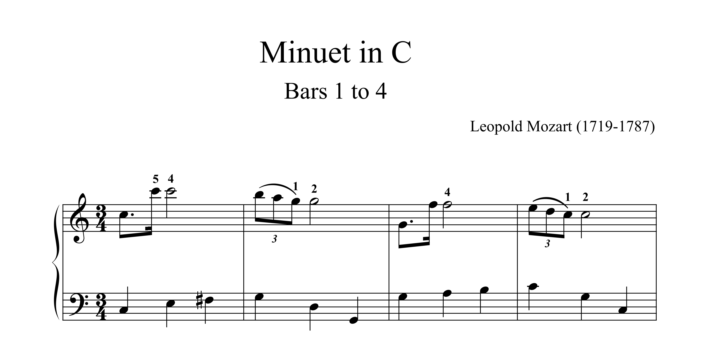
As I do not want to point the finger at someone, I have used my own program, Finale, to copy bars 1 to 4 as the general layout and the used fonts of the original might give you a clue.
As the first four bars for the right hand could already cause trouble, I am going to explain when and how the "creator of the piano fingering" has unfortunately gone wrong.
(N.B.: To avoid any unnerving scrolling, all images are inserted as often as deemed necessary by Giselle Anna Cairns.)
The First and Second Bar
As we are used to play an octave upwards with 1 and 5, this is a quite regular move for us. Quite irregular, however, is the change of finger from 5 to 4 on one and the same “C”.
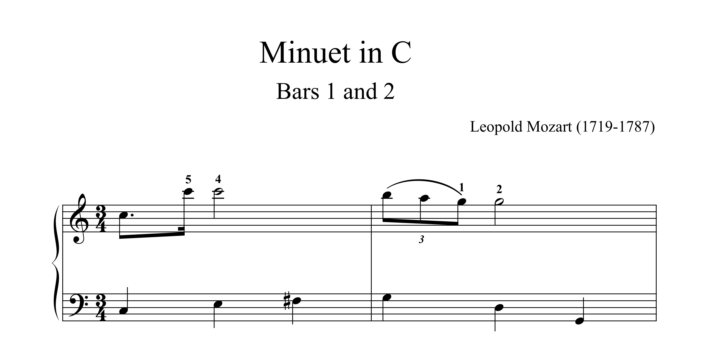
As our thumb and pinkie were situated quite at the edge of the white key area when we played the octave, the move onto the longer finger 4 forces us to move the forearm slightly forwards, but not too far, as there is a black key in the way which we do not want to touch accidentally.
This forward movement might also lead to a slightly heavier pressing down of the key to hold down the minim “C” as long as required. But as this minim “C” is played on an unaccented beat, it could sound louder than musically appropriate.
So what is the reason for the change from 5 to 4 on the “C” in the first bar? In my opinion, this change is utterly useless!
It is not a blessing in disguise as we need finger 5 on the “C”, to get to “B” with 4, “A” with 3, and “G” with 2, which does make the finger change from 1 to 2 on the “G” in the second bar on the last note of the triplet before the minim quite unnecessary.
This finger over suggested in the second bar, I am afraid to say, is even more musically dangerous than the change of finger in the first bar. You have to actively move the whole hand over the thumb, and the second finger could fall into the minim “G” rather forcefully—again on an unaccented beat.
I believe that the editor changed from finger 1 to 2 in the second bar to avoid a loud pressing down of the key by the thumb. However, it is possible to press down a key with the thumb without unnecessary force by hardly lifting the thumb up from the key surface and pressing the key down again by a controlled forearm movement.
Of course, as a non-professional piano player, you may take a given fingering of a known publisher for a good solution. But see it as a mere suggestion and try it out. If it feels wrong for you, you should—by all means—alter it to make it fit your hand.
The Third and Fourth Bar
The third bar requires you to move from “G” up to “F”, and the given fingering is “G” with 1 and “F” with 4. The number 4 is placed above the minim, which is the second note, and not on the semiquaver before that.
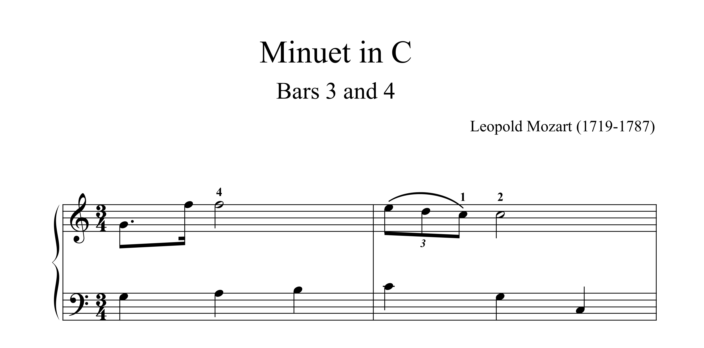
This could mean that you should strike the semiquaver “F” with the fifth finger and then, again, change to 4 on the minim, as it was recommended in the first bar.
For me, the missing finger number on the first “F” is not at all a good idea because it might lead you to strike this “F” with finger 4 already and therefore bring you into the same awkward position as in the first bar, only to execute the next unnecessary finger over in bar 4.
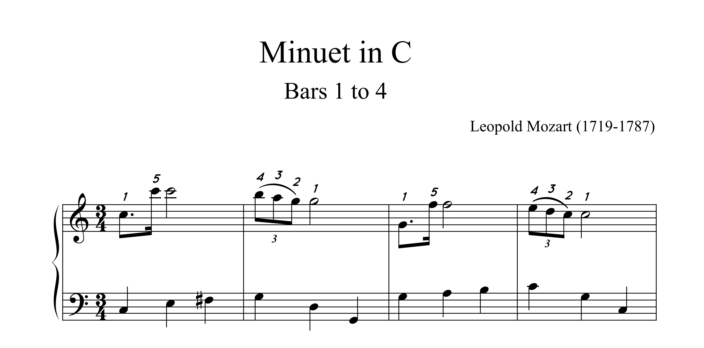
And the result is……that two unnecessary changes from finger 5 to 4 on the same key lead to two changes of forearm position, and to two avoidable finger overs, on two unstressed beats of the bar.
Do I have to offer my condolences to anyone who tries that out…
...instead of this? 
Yours truly,
{Doing it Cairns' Style | Comfort in Every Bar & Certain in Every Key}