


The Blog


Date: October 10, 2026
The De-Cluttered Piano Fingering
My dear Piano Lovers,
I admit that I like watching documentaries of aircraft incidents and am always surprised of how a little incident could lead to a massive catastrophe.
However, playing the piano is as stressful an action as flying an aircraft without a First Officer. You have to play while listening to yourself, while maybe using the pedal, while looking at the score or at your fingers, and even while listening to the person or persons you might be accompanying.
Coming back to the aircraft, a pilot might use a button to de-clutter his screens, leaving only the most important data visible.
Now, what is the most important data in a score? Exactly, the piano fingering. And while a pilot should at any time have all the necessary data on screen(s) in front of him, a piano player should always have the required piano fingering clearly visible in the score, as I already explained in a previous article.
The Printing Quality
Normally, you should not have issues with the printing quality of your score, as it is normally black on white.
While using dark-black letters against a white background on a tablet or computer screen might be too hard a contrast after a while, it is the non-plus ultra for a printed-out score.
But if your eyesight is not as good as it used to be, you may encounter problems “deciphering” the rather tiny piano fingering or even the notes.
Therefore, I decided some time ago that I would enhance the quality and size of the finger numbers of the piano fingering for my students.
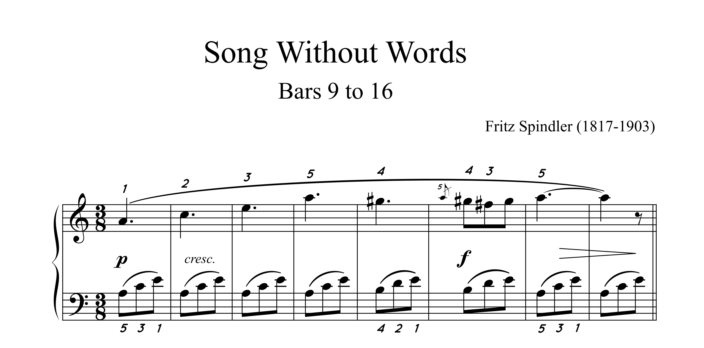
(N.B.: To avoid any unnerving scrolling, all images are inserted as often as deemed necessary by me, Giselle Anna Cairns.)
The Layout
The piano fingering is ideally placed over the right and below the left hand notes, leaving enough room for the dynamics in between.
Ideally, the piano fingering ought not be placed under a tie, but rather a little distance above it to guarantee an easy readability.
The distance between the left hand musical score in one line and the right hand musical score below that should not be too small to ensure perfect readability of very low notes (in the left) or very high notes (in the right) hand.
A good solution would be a clearly visible white stretch between each accolade where the bar numbers might be placed and not be confused with the finger numbers.
The “How Much of” Piano Fingering
As too much might be as bad as too little, I should not repeat a finger number if it would be for exactly the same note in the same bar.
Additionally, I would also not repeat a finger number over a sustained note—no new finger number, no new pressing down of this key.
In case you have to play the same notes in consecutive bars, I would deem it unwise to repeat the same piano fingering over again in every single bar. No new piano fingering under the same notes should make you feel certain that your hand (and mind) can rest (assured) in just the same place on the keyboard.
Piano fingering in ornaments, however, just as at this acciaccatura, should, at least in my opinion, be as close as possible to the little note and not be placed next to the others. This finger number is usually smaller and might be overlooked if positioned next to its larger peers.
I believe one should “start afresh” at every new bar, even if the same note has just been played with exactly that finger.
The same goes for the beginning of a new accolade.
Thus, the de-cluttered score with the ideal piano fingering should relax your eyes and your mind, making you feel comfortable enough to almost “fly this score” and play this piece with ease and fun.
Yours truly,
{Doing it Cairns' Style | Comfort in Every Bar & Certain in Every Key}