


The Blog


Date: September 30, 2026
last updated on October 5, 2026
The Missing Link
My dear Piano Lovers,
Perhaps you remember my previous article “Really tried and tested?“ in which I wrote about a manageable piece which was made difficult to play by the given piano fingering of the editor in question?
Now, I would like to talk about bars five to eight of this piece and explain why one should always try to create a smooth solution from one bar to the next.
(N.B.: To avoid any unnerving scrolling, all images are inserted as often as deemed necessary by me, Giselle Anna Cairns.)
Where the End of Bar Four Left Off
The editorial piano fingering left you with finger 2 on “C” and proposes to start on the next (higher) “E” with finger 1.
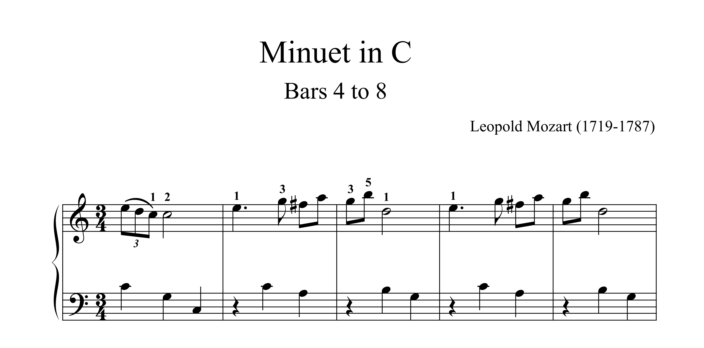
As this is quite an awkward movement, you have to check if it makes sense because you might be able to re-use—I always call it “recycle”—it in bar seven where this two-bar-phrase starts all over again.
To make a long story short: it does not make sense.
At the end of bar six you end on “D” with finger 1 and are required to restart on finger 1 one key above that, on “E”. This “thumb jumping” is hardly ever a good idea.
Bars Five to Eight
The crucial part is to find a solution to start on the dotted crotchet “E” (at the beginning of bar five) in the same way as at the beginning of bar seven. However, the keys just before that restart are not one and the same. In bar four you end on the minim “C” and in bar six on a minim “D”.
Regardless of whether or not you decided to end bar four on finger 2, as given by the editor, or on finger 1, as proposed by me, it might be a good idea to play the dotted crotchet “E” with finger 2.
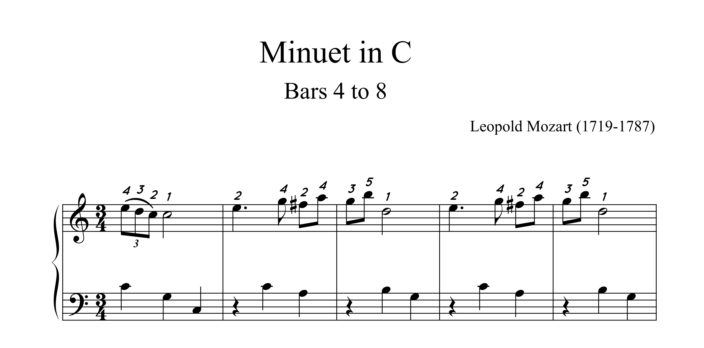
I am going to lead you through the next two bars Finger-by-Finger and Key-by-Key and hope that this might help you to play without any unnecessary jumps.
As already mentioned, I start on the

dotted crotchet “E” with finger 2,
up to quaver “G” with finger 3,
down to quaver “F sharp” with finger 2,
up to quaver “A” with finger 4,
down to quaver “G” with finger 3,
up to quaver “B” with finger 5, and finally
down to minim “D” with finger 1.
I presume that you already notice the difference of Doing it Cairns’ Style like this: By starting on finger 2 on the “E” in bar five you are now perfectly enabled to repeat my piano fingering at the beginning of bar 7 without any unnecessary jumping motion of the thumb to “E”.
A Different Form of “Copy & Paste”
This way of recycling piano fingerings for one and the same phrase is a thing I like to do very much.
This editorial piano fingering is not an uncommon solution, since all the great publishers and editors seem to rely on a published piano fingering for years without ever questioning its feasibility.
So, it is quite normal that you should find this exact piano fingering by more than one publisher, editor or freely accessible on the Internet.
Always question the printed fingering—and just trust yourself. Because if it feels wrong, it is wrong for you.
Yours truly,
{Doing it Cairns' Style | Comfort in Every Bar & Certain in Every Key}