


The Blog


20 October 2026
last updated on 23 October 2026
Making it Possible
My dear Piano Lovers,
In my previous blog articles Really Tried and Tested? and The Missing Link I provided a few tips for one of Leopold Mozart's pieces for his son, the famous Wolfgang Amadeus Mozart, and I have already got this far
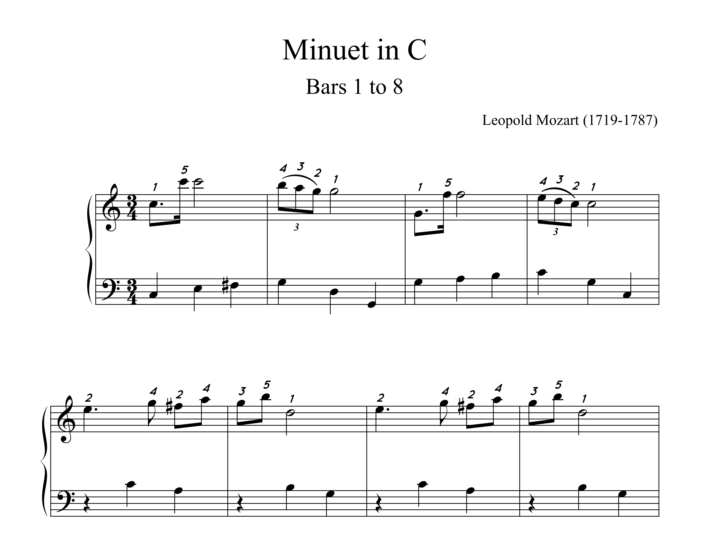
to the end of bar eight.
(N.B.: To avoid any unnerving scrolling, all images are inserted as often as deemed necessary by me, Giselle Anna Cairns.)
The Editorial Piano Fingering Bars 8 to 10
Even though the editor did not provide us with a fingering for the “D” in bar eight, I presume you remember that I proposed to strike this key with finger 1.
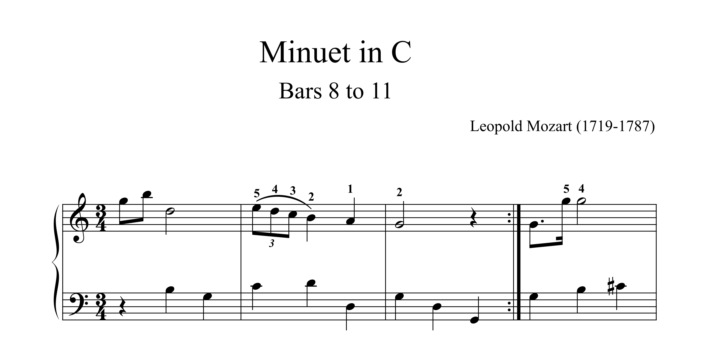
But once again, you seemed to be required to begin a new phrase with a piano fingering which is, at least, open to discussion.
Why, in piano’s name, should you start a sequence of six neighbouring keys with Finger 5, knowing from the start that the sheer number of your fingers would not suffice?
To be quite honest with you: I have really no idea at all.
This ending on “G” with finger 2 is no help at all in case you go back to the beginning and repeat or continue in bar 11, where you face an octave jump from the very same “G” to the “G” one octave above which has to be played with fingers 1 and 5 in quick succession.
Therefore, I suggest to use a most natural solution to play these six keys in bars nine and ten by doing a finger over, quite as originally suggested by the unmasked  editor, but at a different place, and begin on
 the “E” with finger 3, further down tothe “D” with finger 2,
the “C” with finger 1 (this ends the triplet).
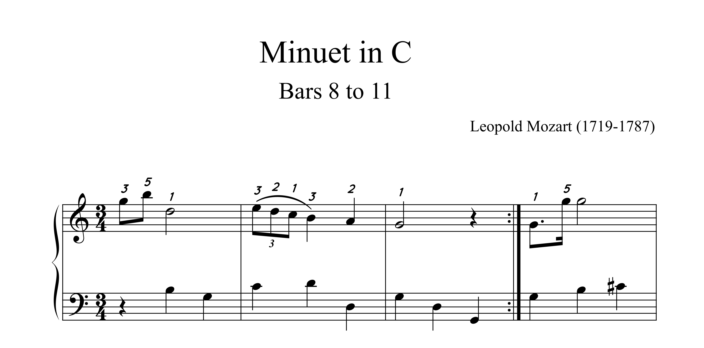
Then you might execute a finger over and play
the crotchet “B” with finger 3,the crotchet “A” with finger 2, andthe minim “G” with finger 1.
A finger over from finger 1 to 3 should, however, ideally be executed in a way that finger 1 is placed far back on the edge of the white key—"C” in question—, allowing the longer finger 3 to literally slide past over the tip of finger 1 and position itself next to it, while finger 1 could still remain on the key. This might give you a visual help as to how far down finger 3 has to travel.
A far-out position of finger 1 at the edge of the white key should also prevent finger 3 from having to make an involuntary movement to prevent itself from bumping into a black key on its way down.
I believe you see what a difference it could make to spend some time over your piano fingering when the result so far is this:
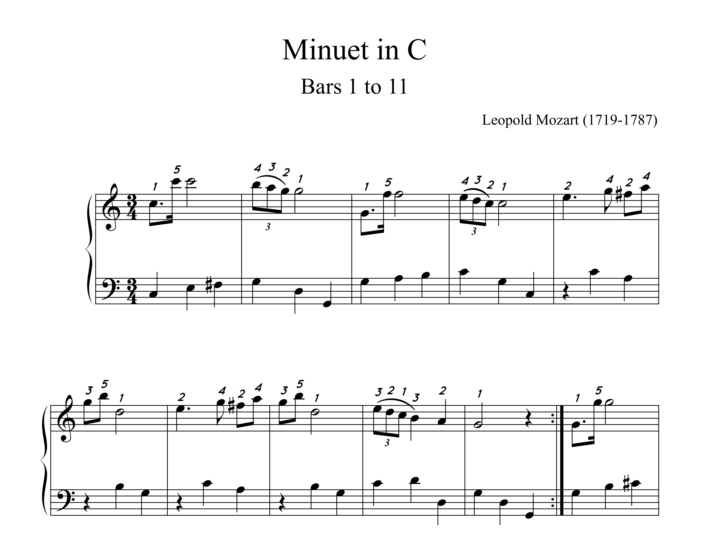
And in the next blog article I am going to finish the piano fingering for the right hand until the end of this piece.
Yours truly,
{Doing it Cairns' Style | Comfort in Every Bar & Certain in Every Key}