


Cairns' News



30 October 2026
last updated on 7 November 2026
Taking the Easy Way Out
My dear Piano Lovers,
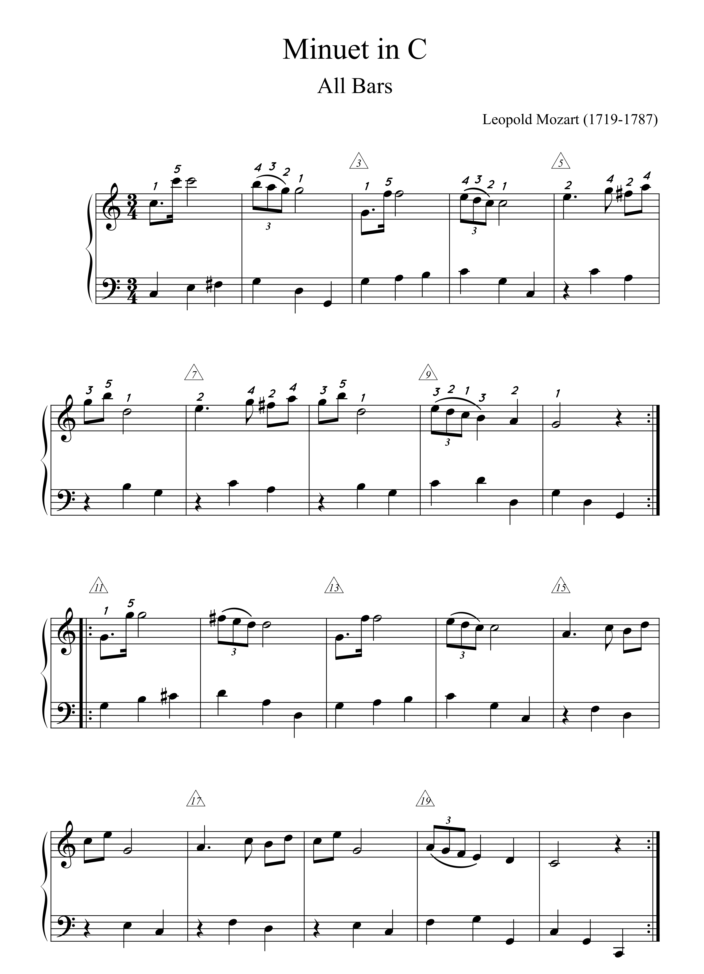
This is the final part of my series on the right-hand piano fingering of Leopold Mozart’s Minuet in C.
It started with Really Tried and Tested?, followed by The Missing Link, and Making it Possible.
You will remember that we reached bar eleven and still have to find a suitable piano fingering for bars twelve to twenty.
(N.B.: To avoid any unnerving scrolling, all images are inserted as often as deemed necessary by me, Giselle Anna Cairns.)
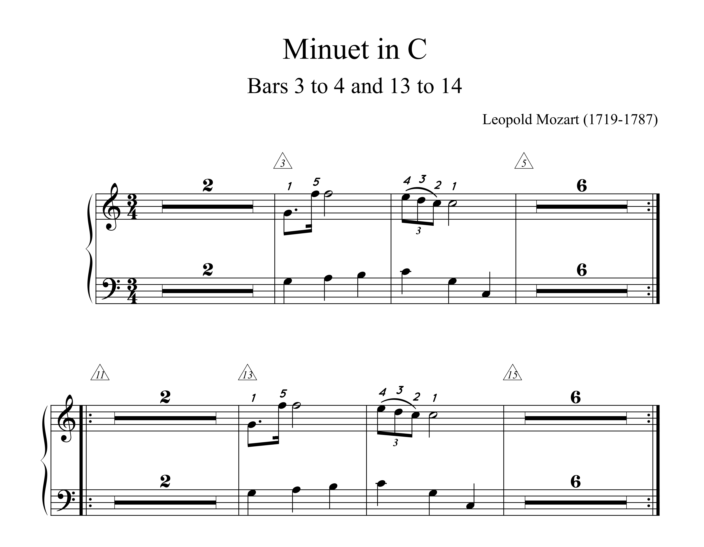
Recycling bars 3 to 4
You may remember my thoughts on recycling piano fingerings, which I will now put straight into practice at the keyboard.
As bars thirteen and fourteen are identical to bars three and four, we can cut a long story short and reuse this already tried and tested piano fingering.
My Recycling 2.0
You may remember my thoughts on recycling piano fingerings in my article The Missing Link.
While I previously applied this concept to bars that were exactly the same, it can also be used for transposed or otherwise related passages.
Therefore, I am going to use the knowledge of a working piano fingering I have already established for as many of the remaining bars as possible.
Composers—and Leopold Mozart is no exception to the rule—are prone to reuse their (in their opinion) most melodious passages, and so did he.
The octave jump from "C" to "C" in bar one, with the subsequent downward movement in bar two in the original C major, is transposed down to G major in bar eleven.
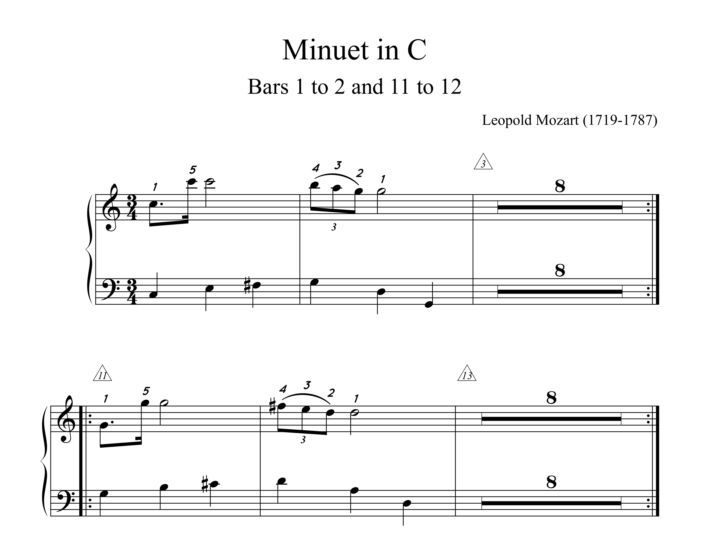
As you have certainly already observed, bar twelve mirrors bar two and we can save ourselves time and trouble by simply recycling the piano fingering we have already used.
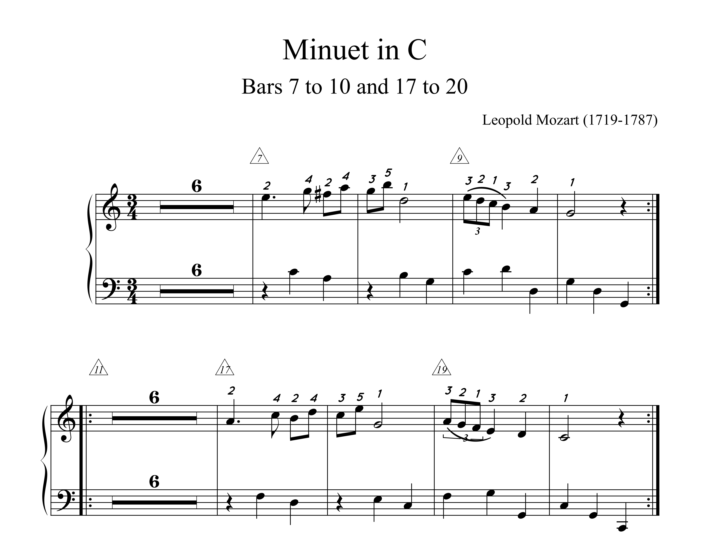
The same applies to bars seventeen to twenty, as they are a transposed copy of bars seven to ten.
Does a new broom really sweep clean?
No, I have not lost my mind while writing this article for you, my dear Piano Lovers.
The last bars I need to examine for you are bars fourteen and fifteen.
Taking the headline "taking the easy way out" literally, you could just use the piano fingering of bars four and five again.
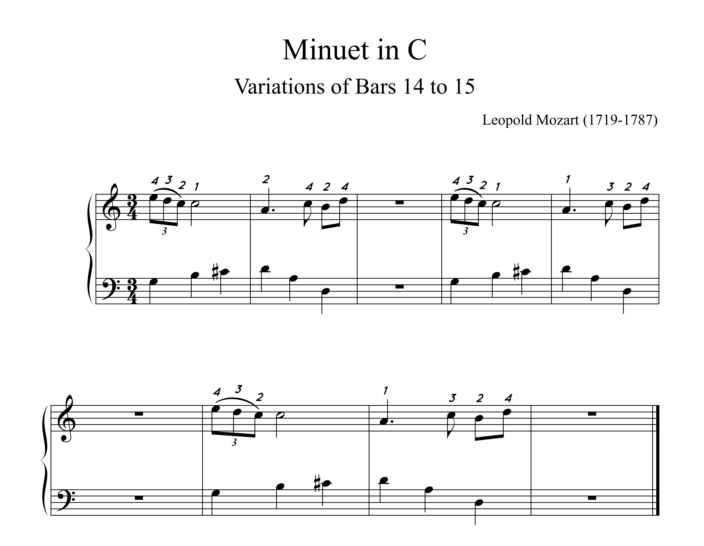
However, ending bar fourteen with finger 1 on "C" and continuing with finger 2 on "A", just a third lower, might not feel as comfortable as you might wish.
Since I am not in favour of "thumb jumping", I only offer this next solution for the sake of completeness.
A third alternative to consider is to end bar fourteen with finger 2 on the "C", thereby providing a clean start with finger 1 for the "A" at the beginning of bar fifteen.
This initial combination of fingers 1 and 3 for the first two notes could then be smoothly adapted to the previously used combination of 2 and 4 to continue the passage.
All three alternatives for this passage are doable, but their practicability should ultimately be decided by you as the player.
You may agree with me that the "thumb jumping" alternative is not practical at all.
Furthermore, changing the piano fingering of a passage you have already played three times before reaching bar fourteen might cause unnecessary mental strain.
Thus, such changes are only useful if there is truly no other playable alternative available.
In my opinion, we should disregard any "new broom" approach and carry on with the piano fingering we used in bar five.
Only this time, we simply drop our second finger down (and the rest of the hand over) onto the "A" to play bar fifteen exactly as we played bar five.
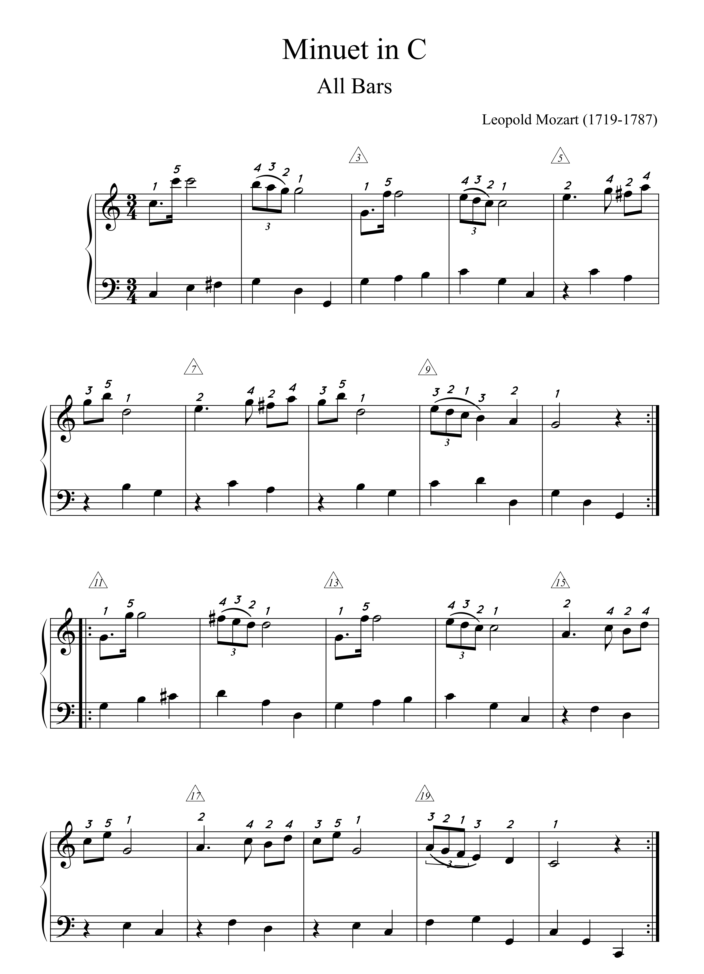
This concludes my four-part series on Leopold Mozart’s Minuet in C. The final piano fingering for the right hand, for me at least, stands thus:
Yours truly,
{Doing it Cairns' Style | Comfort in Every Bar & Certain in Every Key}
This Cairns' News article is part of a series that started with « Really Tried and Tested?, continued with « The Missing Link, followed by « Making it Possible, and ended with Taking the Easy Way Out (this article).